
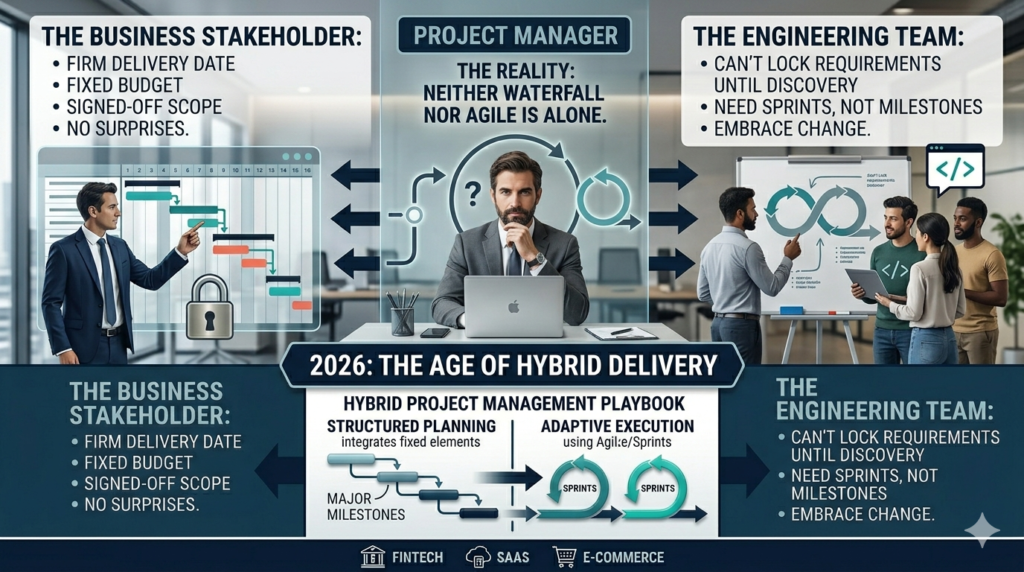
Most project managers I know have been in this meeting before.
The business stakeholder says: “We need a firm delivery date, a fixed budget, and a signed-off scope. No surprises.”
The engineering team says: “We can’t lock requirements until we’ve done discovery. We need sprints, not milestones.”
You’re sitting in the middle, nodding at both sides, knowing neither pure Waterfall nor pure Agile is going to get this project across the line alone.
That’s not a failure of methodology. That’s reality. And in 2026, the most effective delivery leaders have stopped debating Agile vs Waterfall entirely — they’ve moved on to something more practical: hybrid project management.
This post is a working playbook. It covers when hybrid delivery makes sense, which framework to reach for, how to structure governance without killing agility, and what this actually looks like in practice across the teams I’ve worked with in fintech, SaaS, and e-commerce.
Key Takeaways
- Hybrid project management deliberately combines Agile and Waterfall where each works best — it is not a compromise, it is a design decision.
- 89% of high-performing organisations now use hybrid delivery approaches.
- The most common hybrid patterns are Water-Scrum-Fall, Agile + Stage-Gate, SAFe with fixed milestones, PRINCE2 Agile, and ScrumBan.
- Effective hybrid delivery works in four layers: Portfolio Governance, Release Planning, Team Delivery, and Integration Management.
- The Senior PM’s role in hybrid delivery is translation — converting between two operating models without losing meaning in either direction.
Why Hybrid Project Management Is Now the Default
For years, Agile evangelists declared Waterfall dead. Then organisations tried to run everything as Scrum, and realised that fixed contracts, regulatory audits, and executive budget cycles don’t disappear because you switched to sprints.
The data has caught up with the reality on the ground. According to recent industry research, 89% of high-performing organisations now use hybrid delivery approaches. A PMI Pulse of the Profession report recorded a 57% increase in hybrid adoption as organisations blend structured planning with adaptive delivery models. In 2026, hybrid approaches are used in approximately 60–70% of successful large-scale projects worldwide.
This isn’t a compromise. It’s a design decision — one that, when made deliberately, dramatically improves both delivery predictability and stakeholder confidence.
The honest reason most teams end up hybrid is simpler: different parts of any large project have different natures. Infrastructure work is sequential. Product discovery is iterative. Vendor contracts are fixed. Feature development is adaptive. A single methodology applied uniformly to all of it creates friction by design.
What works is matching the method to the work — not the team’s preference or the organisation’s historical default.
Agile vs Waterfall vs Hybrid: A Quick Comparison
Before choosing your hybrid model, it helps to be precise about what each methodology brings to the table and where it breaks down.
| Waterfall | Agile | Hybrid | |
|---|---|---|---|
| Planning approach | Fixed upfront, sequential phases | Rolling, sprint-by-sprint | Fixed at programme level, adaptive at team level |
| Scope flexibility | Low — changes are expensive | High — backlog evolves continuously | Mixed — fixed at governance layer, flexible at delivery layer |
| Governance style | Stage gates, formal sign-offs, audit trails | Lightweight, sprint reviews, retrospectives | Layered — formal gates for milestones, Agile ceremonies for execution |
| Stakeholder reporting | Milestone reports, Gantt charts | Sprint demos, velocity charts | Both — translated into appropriate views per audience |
| Best for | Fixed scope, regulated environments, hardware/infrastructure | Evolving requirements, product discovery, digital delivery | Complex programmes with mixed work types, multi-stakeholder environments |
| Risk profile | Risks surface late (end of each phase) | Risks surface early (each sprint) | Risks managed at both layers — early in sprints, formally at gates |
| Team size | Any, scales with PMs and phase leads | Small to mid-size teams preferred | Enterprise scale — multiple teams with different working styles |
The key insight: most enterprise programmes have components that belong in different columns of this table. That’s precisely why hybrid exists.
What Hybrid Project Management Actually Means
Hybrid project management is the deliberate combination of two or more delivery methodologies, applied where each is strongest — rather than forcing one framework to cover everything.
The key word is deliberate. Most teams are already running hybrid by accident. They use Waterfall for planning and reporting, Agile for sprint execution, and switch back to Waterfall for UAT and deployment. This is sometimes called Water-Scrum-Fall, and it’s more common than most organisations admit.
The difference between accidental hybrid and effective hybrid is intentionality and governance design. When you’re deliberate about it, you define the handoff points clearly, you communicate the method rationale to stakeholders, and you build reporting that bridges both worlds.
The Five Most Common Hybrid Frameworks
1. Water-Scrum-Fall Waterfall governs the beginning (requirements, contracts, budget approval) and the end (UAT, deployment, sign-off). Scrum runs the middle — iterative development sprints. This works well for software projects inside traditionally-managed organisations where governance gates are non-negotiable but development teams are already Agile. It is the most widely adopted hybrid pattern in enterprise IT.
2. Agile + Stage-Gate Agile delivery runs within structured stage-gate phases. Each gate is a major go/no-go decision point — funding approval, architecture sign-off, release authorisation — but work inside each stage follows sprint-based Agile principles. Common in regulated industries and innovation programs requiring executive oversight at defined milestones.
3. SAFe with Fixed Milestones Scaled Agile Framework (SAFe) for enterprise delivery, overlaid with fixed milestone reporting for board or investor commitments. PI Planning gives the Agile heartbeat; quarterly milestone reports give finance the fixed checkpoints they require. This is the pattern I’ve seen work most consistently in large fintech transformations.
4. PRINCE2 Agile PRINCE2’s governance framework — with its defined roles, management stages, and tolerance-based control — combined with Agile delivery methods at the team level. PRINCE2 Agile is particularly effective in UK public sector, regulated financial services, and any environment where structured project governance is a contractual or compliance requirement. Given my PRINCE2 background, this is a pattern I reach for when governance accountability is non-negotiable but team-level flexibility still matters.
5. ScrumBan A hybrid of Scrum’s sprint structure and Kanban’s flow-based visualisation. Teams use Scrum for planning cadence and sprint goals, but manage work-in-progress limits and continuous flow like Kanban. Particularly effective for support and maintenance teams that need both predictable planning cycles and the ability to handle unplanned work without blowing up the sprint.
6. Disciplined Agile Delivery (DAD) DAD provides a toolkit of delivery strategies rather than a single prescribed process. Teams choose the right lifecycle — Agile, Lean, Continuous Delivery, or Exploratory — for each workstream within a programme. More sophisticated than SAFe to implement but more flexible for complex, heterogeneous portfolios.
When to Use Hybrid (and When Not To)
Hybrid delivery isn’t the answer to every project. Before reaching for it, it helps to be honest about what’s actually driving the requirement.
Hybrid delivery is the right call when:
- Requirements clarity is mixed. Some components have well-defined, fixed requirements (integration contracts, compliance controls, infrastructure) while others need iteration (user experience, product features, reporting).
- Governance is non-negotiable. Regulatory bodies, procurement processes, or board commitments require structured approvals at defined checkpoints — but execution teams need flexibility.
- Multiple stakeholder groups with different needs. Finance wants milestone-based reporting and fixed delivery dates. Product wants sprint reviews and backlog flexibility. Hybrid lets you service both without creating two separate truths.
- Vendor dependencies exist. Third-party vendors often work to fixed contracts and milestones. You can maintain Agile execution internally while managing vendor interfaces with Waterfall rigour.
- The team is transitioning to Agile. Hybrid is often the practical bridge when an organisation is moving from Waterfall to Agile and isn’t ready to operate at full Agile maturity.
When hybrid adds complexity without value:
- Small, co-located teams with high trust and no external compliance requirements — pure Agile is faster and simpler.
- Projects with truly fixed scope, timeline, and budget where no iteration is expected — Waterfall’s clarity is the advantage, not a limitation.
- Teams that lack the PM maturity to manage two operating models simultaneously — hybrid requires more active coordination, not less.
The Benefits of Hybrid Project Management
When implemented deliberately, hybrid delivery delivers measurable advantages that neither pure methodology can match alone.
Risk reduction. Agile’s short feedback loops surface problems early within each sprint. Waterfall’s structured stage gates catch programme-level risks before they compound. The combination gives you risk visibility at both the micro and macro levels, something neither methodology achieves alone.
Stakeholder confidence. Fixed milestones give executives and boards the predictability they need for planning and reporting. Sprint-based delivery gives product and engineering the flexibility to adapt without losing momentum. Both groups get what they need from the same programme.
Faster delivery of value. By running Agile execution within a Waterfall governance frame, teams can ship working product incrementally without waiting for the end of a phase. Value reaches users earlier; feedback loops shorten.
Compliance readiness. Regulated industries, financial services, healthcare, and government require documented approvals, audit trails, and defined accountability. Hybrid preserves these requirements at the governance layer while allowing modern delivery practices at the team level.
Scalability across teams. Hybrid frameworks accommodate multiple teams with different operating styles, an infrastructure team running sequential phases, a product team running sprints, a vendor on a fixed contract, within a single coherent programme structure.
Building Your Hybrid Delivery Framework: The Four-Layer Model
Over the years I’ve worked across fintech, SaaS, and e-commerce delivery programs, I’ve found that effective hybrid delivery works in four layers. Each layer has a clear owner and a clear operating rhythm.
Layer 1: Portfolio / Programme Governance (Waterfall Layer)
Cadence: Quarterly
What belongs here:
- Business case approval and budget sign-off
- Programme-level milestone plan (key delivery dates visible to exec and board)
- Risk and dependency register at programme level
- Vendor contract management and milestone payments
- Regulatory or audit checkpoints
Who owns it: Programme Manager / RTE (Release Train Engineer in SAFe contexts)
This layer uses Waterfall discipline — fixed milestones, stage gates, structured change control. Changes here trigger a formal process. Stakeholders at this layer see a milestone plan, a RAG status report, and a risk register — not a sprint backlog.
Key principle: This layer exists to maintain confidence and accountability at the organisational level. It doesn’t drive how teams work day to day — it frames the boundaries within which teams operate.
Layer 2: Product / Release Planning (Translation Layer)
Cadence: Monthly or per PI (Programme Increment)
What belongs here:
- Breaking programme milestones into product increments or releases
- Capacity planning across teams
- Dependency identification between Agile teams and Waterfall workstreams
- Release readiness checklist
- Stakeholder communication: translating sprint output into milestone progress
Who owns it: Product Manager / Senior PM
This is the translation layer — where Waterfall commitments become Agile work, and Agile output becomes milestone evidence. It’s the most intellectually demanding layer to run well, because you’re managing two vocabularies simultaneously.
A sprint velocity chart means nothing to the CFO. A milestone health dashboard means nothing to the dev team. The translation layer converts both into meaningful signals for the right audience.
Tool I use: I’ve found a simple one-page release plan — showing milestones on top and sprint deliverables mapped beneath them — does more for cross-functional alignment than any complex project management tool alone.
Layer 3: Team Delivery (Agile Layer)
Cadence: Sprint / 2-week cycle
What belongs here:
- Sprint planning, daily standups, sprint reviews, retrospectives
- Backlog refinement and story estimation
- Team velocity tracking
- Definition of Done enforcement
- Engineering quality gates (code review, testing, CI/CD)
Who owns it: Scrum Master / Engineering Lead / Product Owner
This layer operates with full Agile discipline. The team’s primary concern is delivering shippable increments within each sprint. They shouldn’t be burdened with milestone language or governance overhead — that’s what Layers 1 and 2 are for.
Key principle: Protect the Agile layer from governance noise. If every sprint review becomes a board-level status meeting, teams lose the psychological safety that makes Agile work.
Layer 4: Risk and Integration Management (Cross-Cutting Layer)
Cadence: Weekly
What belongs here:
- Cross-team dependency tracking
- Escalated blockers from sprint teams
- Integration testing coordination
- Third-party / vendor status
- Risk log updates feeding into Layer 1 governance
Who owns it: Senior PM / Delivery Lead
This layer is often neglected in hybrid setups, which is why so many hybrid programs fall apart at the integration points. Dependencies between Agile teams and Waterfall workstreams need active management — they don’t resolve themselves.
I run a weekly 45-minute integration sync that brings together the leads from each workstream, specifically to surface cross-boundary risks before they become escalations.
How to Implement Hybrid Project Management: A 6-Step Guide
Knowing the theory is one thing. Rolling out a hybrid model across a real organisation is another. Here is the step-by-step approach I’ve used across multiple programmes.
Step 1: Assess your current state Document how teams currently work. Which departments use Waterfall? Where is Agile already running? Where does friction exist at the handoffs between them? Create a simple inventory: teams, their current methodology, and the integration points where work crosses between them. This is your baseline — and it almost always reveals that you’re already hybrid by accident.
Step 2: Map work types to methodology Go through your programme scope and classify each workstream: fixed-requirement sequential work (Waterfall), iterative discovery and delivery work (Agile), or vendor-managed work (contractual Waterfall externally, flexible internally). This mapping becomes the foundation for your governance design.
Step 3: Design the governance architecture Define your four layers (or a simplified version for smaller programmes). Write down which decisions require formal change control vs backlog priority change. Document the stage gate entry criteria. Design the reporting views for each stakeholder group. Get this agreed and signed off before the programme kicks off — not after the first crisis.
Step 4: Align stakeholders on the model Run a kick-off session specifically for the hybrid model — not the project scope, just the way of working. Executives need to understand what they will and won’t see at sprint reviews. Engineering leads need to understand how sprint output connects to milestone commitments. This session prevents 80% of the governance conflicts that emerge later.
Step 5: Pilot on one workstream Don’t flip the entire programme to hybrid simultaneously. Choose one workstream — ideally one with a clear Agile delivery component and a clear Waterfall milestone dependency — and run the four-layer model for one PI or one quarter. Collect feedback. Adjust before scaling.
Step 6: Iterate and scale Apply lessons from the pilot across the rest of the programme. Run a retrospective at the end of each PI that includes both the governance layer and the delivery layer. The hybrid model itself should be treated like a product — continuously improved based on what’s working and what isn’t.
Governance Without Killing Agility: The Practical Rules
The most common failure mode in hybrid delivery is governance creep — where Waterfall controls designed for Layer 1 slowly migrate down into Layer 3, suffocating the Agile teams underneath.
Here are the rules I’ve seen work in practice:
Rule 1: Separate the reporting layers physically. Milestone reports go to executives. Sprint reviews go to the product team. Never conflate them. When executives attend sprint reviews expecting milestone updates, teams start performing for governance rather than delivering value.
Rule 2: Define the change control boundary clearly. Changes to milestone dates or programme-level scope follow formal change control. Changes to sprint backlog priority do not. Write this down and share it with all stakeholders at project kick-off.
Rule 3: Stage gates should be lightweight decisions, not heavyweight reviews. A stage gate is a go/no-go. It should take 30 minutes if the evidence is prepared. If it takes three weeks of document preparation, you’ve built a governance theatre, not a governance process.
Rule 4: Surface dependencies early, not late. In hybrid environments, the dependencies between Agile workstreams and fixed Waterfall milestones are where programmes die. Build a dependency register in week one. Review it weekly. Don’t let it become a historical artifact.
Rule 5: Align on a single source of delivery truth. One dashboard. One place where milestone status, sprint health, and risk status live together. Different stakeholders look at different views of the same data — not different tools with different data.
This links directly to what I covered in The Software Delivery Visibility Problem — the biggest challenge in hybrid delivery is often not execution, it’s keeping everyone aligned on what’s actually true.
What This Looks Like in Practice: A Fintech Example
To make this concrete, here’s how I’ve applied this model in a core banking transformation programme — the kind of project where you simply cannot choose between Agile and Waterfall, because you need both.
The challenge: A mid-size fintech replacing its core banking platform while maintaining live operations. Regulatory submission required fixed milestone dates. Development teams were already Agile. Third-party vendors were on fixed delivery contracts.
How the hybrid model was applied:
Layer 1 (Quarterly): Programme milestone plan with five major gates — Architecture Approval, Integration Readiness, UAT Entry, Regulatory Submission, Go-Live. Each gate had clear entry criteria. Regulatory and vendor dependencies mapped at this level.
Layer 2 (Monthly): Product increments aligned to each gate. Monthly release planning sessions translated sprint outputs into gate readiness evidence. A single release readiness checklist kept all workstreams accountable.
Layer 3 (Fortnightly): Five Agile teams running independent sprints. Each team’s sprint goals were linked explicitly to the relevant programme milestone. Sprint reviews were internal — executives received a monthly milestone update instead.
Layer 4 (Weekly): A 45-minute integration sync across all team leads. The only agenda: blockers, dependencies, vendor status. No status theatre — just decisions.
The outcome: The programme delivered the regulatory submission milestone on schedule. Two sprints slipped internally and were recovered within the same PI without affecting the external milestone. The team had the agility to absorb changes mid-delivery while the board saw consistent milestone confidence.
This also ties into the broader point I made in Agile Metrics for Predictable Delivery — the metrics you track need to serve the layer you’re reporting to, not just the team running the sprint.
Common Mistakes in Hybrid Delivery (and How to Avoid Them)
Mistake 1: Treating hybrid as a temporary state. Many organisations go hybrid “while transitioning to full Agile.” In practice, most enterprises never fully abandon structured governance, nor should they. Design your hybrid model as a sustainable operating system, not a stepping stone.
Mistake 2: Letting the Waterfall layer expand downward. Programme governance should govern programme decisions. When it starts governing sprint priorities, story estimates, or team ceremonies, you’ve lost the agility that made hybrid worth the effort.
Mistake 3: No defined handoff points. When does a sprint deliverable become milestone evidence? Who certifies that a piece of work meets the gate entry criteria? Without clear handoff definitions, work disappears into a gap between the two layers.
Mistake 4: One stakeholder group, two different truths. If your executive sponsor hears milestone status from the PMO and sprint velocity from the dev team, and those two signals don’t reconcile, you have a communication architecture problem, not a delivery problem.
Mistake 5: Underestimating the PM’s coordination load. Hybrid delivery places a heavier cognitive load on the Senior PM than either pure Agile or pure Waterfall. You’re running two operating models, managing two stakeholder vocabularies, and maintaining coherence across all layers simultaneously. This is a senior role. Staff it accordingly.
Tools That Support Hybrid Project Management
The right tool stack won’t fix a broken governance model, but the wrong one will make a good model harder to run. Here is how the main options map to the four-layer framework — and where each one is strongest.
| Tool | Best hybrid layer | Gantt view | Kanban/sprint view | Best for |
|---|---|---|---|---|
| Jira | Layer 2 + 3 | Via Roadmaps | Yes (Scrum + Kanban boards) | Engineering teams; sprint tracking; backlog management |
| Linear | Layer 3 | Via Cycles | Yes | Product and engineering teams wanting a lighter Jira |
| Smartsheet | Layer 1 + 2 | Yes (native) | Limited | Executive milestone tracking; programme governance |
| MS Project | Layer 1 | Yes (native) | No | Traditional programme planning; vendor milestone tracking |
| Confluence | All layers | No | No | Documentation; dependency registers; release plans |
| Azure DevOps | Layer 2 + 3 | Yes (Delivery Plans) | Yes | Enterprise Microsoft environments; mixed DevOps teams |
My practical recommendation: Use Smartsheet or MS Project for Layer 1 milestone visibility. Use Jira or Linear for Layer 3 sprint execution. Bridge them with a monthly release plan document in Confluence that translates between the two — this is cheaper and more reliably maintained than trying to find one tool that does everything.
I’ve also been experimenting with using AI to accelerate the translation layer work — specifically using Claude to draft milestone update narratives from sprint data, and to identify dependency risks across workstreams. More detail on this in AI for Software Project Estimation.
A Hybrid Delivery Readiness Checklist
Before launching a hybrid programme, work through these questions:
Governance design:
- Have you defined which decisions require formal change control vs backlog priority change?
- Are stage gate entry criteria documented and agreed with all stakeholders?
- Is there a single dashboard that both Agile and governance stakeholders can read?
Stakeholder alignment:
- Does every stakeholder group have a defined reporting view (milestone report vs sprint review)?
- Has the change control boundary been communicated in writing at kick-off?
- Do executive sponsors understand what they will and won’t see in sprint reviews?
Team protection:
- Are Agile ceremonies protected from governance attendance?
- Do sprint goals explicitly link to milestone outcomes so teams understand the connection?
- Is there a clear escalation path for blockers that cross the Agile/Waterfall boundary?
Integration management:
- Is there a dependency register covering cross-boundary dependencies from week one?
- Is there a regular integration sync with a defined attendance list?
- Are vendor interfaces mapped and milestone dependencies with vendors documented?
The Mindset Shift That Makes Hybrid Work
The most important change isn’t structural — it’s how you think about your role as the delivery leader.
In a pure Waterfall programme, the PM’s job is control: scope, schedule, budget, change. In pure Agile, the PM’s job is facilitation: remove blockers, enable the team, protect the process.
In hybrid delivery, the PM’s job is translation — holding two operating models in parallel, converting between their languages without losing meaning, and maintaining trust in both directions simultaneously.
That’s a harder skill to teach than any methodology. It requires genuine comfort with ambiguity, strong stakeholder communication, and the credibility to tell an executive that milestone delivery confidence is green even when a sprint is having a rough fortnight — and to be believed.
If you’re stepping into a hybrid delivery role for the first time, I’d suggest reading the Software Project Estimation Guide alongside this — because estimation discipline is what connects sprint output to milestone commitments credibly.
Frequently Asked Questions
What is the difference between hybrid and Agile project management? Agile project management uses iterative, sprint-based delivery with evolving requirements and lightweight governance. Hybrid project management adds a Waterfall governance layer on top — fixed milestones, formal change control, and structured reporting — while keeping Agile at the team execution level. Hybrid is designed for environments where Agile alone cannot satisfy stakeholder, compliance, or contractual requirements.
When should you use hybrid project management? Hybrid is the right choice when your programme has mixed work types (some fixed, some iterative), multiple stakeholder groups with different reporting needs, regulatory or contractual governance requirements, or vendor dependencies managed on fixed contracts. If all of these apply, hybrid isn’t optional — it’s the only realistic approach.
What is Water-Scrum-Fall? Water-Scrum-Fall is the most common hybrid pattern. Waterfall governs the beginning of the project (requirements sign-off, contracts, budget approval) and the end (UAT, deployment, formal sign-off). Scrum runs the development phase in the middle. It’s called Water-Scrum-Fall because the project starts Waterfall, runs Scrum in the execution phase, then finishes with Waterfall governance.
What tools work best for hybrid project management? The most practical combination is Jira or Linear for team-level sprint execution (Layer 3), Smartsheet or MS Project for programme milestone tracking (Layer 1), and Confluence for documentation and the translation layer (Layer 2). Avoid the temptation to find one tool that does everything — the translation between the two worlds is best done by a person, not a tool integration.
Is PRINCE2 compatible with Agile delivery? Yes. PRINCE2 Agile is a formally recognised hybrid approach that combines PRINCE2’s governance framework with Agile delivery at the team level. The PRINCE2 management stages become governance containers within which Agile sprints run. PRINCE2 Agile is widely used in regulated industries and UK public sector projects where PRINCE2 governance is a compliance requirement.
How do you measure success in a hybrid programme? You measure at both layers. At the governance layer: milestone achievement, stage gate pass rate, budget adherence, and risk register health. At the team layer: sprint velocity, story completion rate, defect escape rate, and team happiness. The critical metric is milestone confidence — the gap between what governance expects and what teams are actually delivering — which the translation layer exists to manage.
Summary: The Hybrid Delivery Playbook in Five Lines
- Match the method to the nature of the work — not the team’s preference or the organisation’s tradition.
- Build four clear layers — Portfolio Governance, Release Planning, Team Delivery, Integration Management.
- Protect the Agile layer from governance noise — and protect the governance layer from Agile informality.
- Design the translation layer deliberately — this is where hybrid programmes succeed or fail.
- Staff the Senior PM role seriously — hybrid delivery is a higher coordination load than either pure methodology.
Related Posts
- The Software Delivery Visibility Problem — why milestone confidence breaks down and how to restore it
- Agile Metrics for Predictable Delivery — which metrics to track at each layer of a hybrid programme
- Software Project Estimation Guide — how to produce estimates that hold across Agile and Waterfall boundaries
- AI for Software Project Estimation — using AI to accelerate estimation and dependency analysis
- AI in Project Management — the broader picture of how AI is changing delivery leadership in 2026

Jawed Shamshedi is a Senior Technical Project Manager and Software Delivery Leader with 20+ years of experience in IT and 10+ years in technical project management. He holds PMP®, SAFe® 6 RTE, PRINCE2, and MCP certifications and has led software delivery across e-commerce, finance, healthcare, and SaaS domains. Based in New Delhi, working with clients worldwide.