
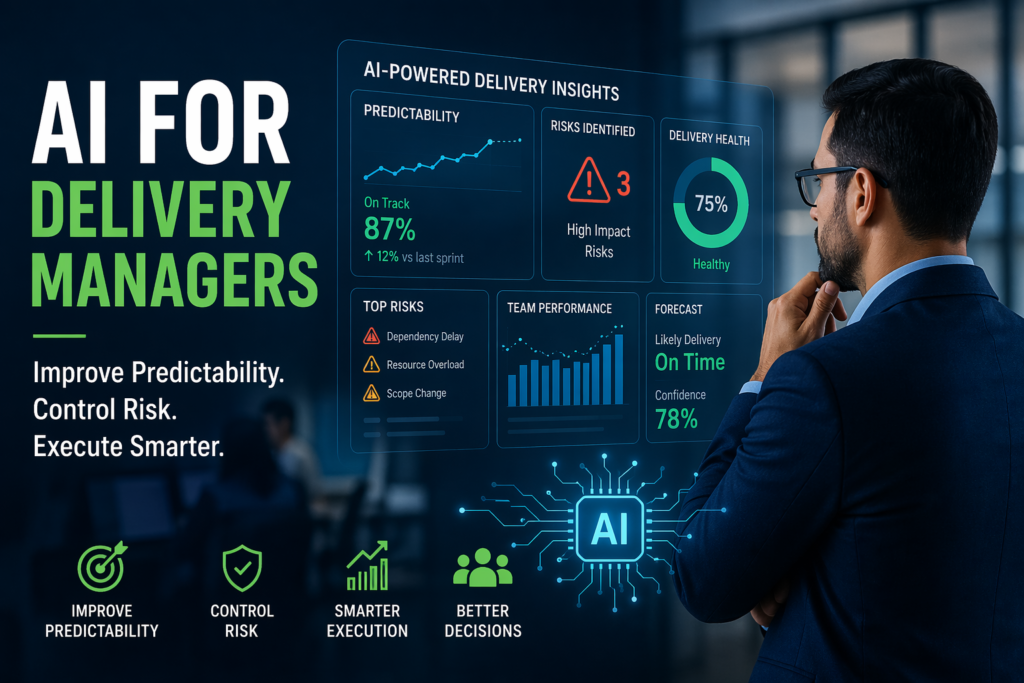
AI for Delivery Managers: 7 Ways to Improve Predictability, Risk Control, and Execution
How senior delivery managers can use AI in project management to move from reactive execution to predictable, data-driven software delivery.
What is AI in project management? AI in project management refers to the use of artificial intelligence to analyze delivery data, predict risks, improve estimation accuracy, and support decision-making across software projects. It helps delivery managers move from manual tracking and reactive problem-solving to proactive, data-driven execution.
AI in project management is no longer a future concept. It is becoming a practical capability for delivery managers who want to improve outcomes in complex software environments.
Managing software delivery today is harder than ever. Distributed teams, increasing business expectations, and tighter timelines have made predictable delivery a real challenge. Delivery managers are no longer just responsible for execution. They are expected to provide visibility, reduce risks, and ensure consistent outcomes across multiple workstreams.
In my experience leading software delivery across e-commerce, finance, and SaaS projects, one thing is clear — complexity is increasing, not decreasing. Traditional approaches alone are no longer enough.
AI in project management changes this.
I do not see AI as a replacement for delivery leadership. I see it as a support layer that enables better and faster decision-making. When used correctly, AI helps identify risks early, reduces manual reporting effort, and provides deeper insight into delivery performance across teams.
In this guide, I will walk through 7 practical ways delivery managers can use AI in project management to improve predictability, control risk, and execute more effectively.
The Real Challenge in Software Delivery Today
Software delivery today is not failing because teams lack tools or frameworks. It is failing because of a visibility problem.
Even with Agile, DevOps, and modern project management tools, most delivery teams still struggle with:
- Increasing delivery complexity across distributed teams
- Lack of real-time visibility into risks and dependencies
- Delayed risk identification — issues surface too late to act on
- Over-reliance on manual reporting that consumes time without adding insight
The result is missed timelines, unexpected dependencies, and poor predictability.
The problem is not execution effort. The problem is that delivery managers lack the data signals they need to make informed decisions early enough to matter.
This is exactly where AI in project management is making a real difference — by turning delivery data into actionable insights before problems escalate.
Strong software project estimation is also part of this foundation. Estimation defines the plan, and AI helps ensure that execution stays aligned with it throughout delivery.
1. Use AI to Improve Delivery Predictability
Predictability is one of the hardest problems in software delivery. Most teams can tell you what happened last sprint. Very few can reliably tell you what will happen next.
AI in project management improves predictability by analyzing historical and real-time delivery data to identify patterns that are difficult to detect manually.
Specifically, AI can:
- Forecast delivery delays based on past sprint performance and team velocity trends
- Identify teams or modules that are consistently at risk of slipping
- Highlight deviations in sprint performance before they become blockers
- Provide early warning signals before issues escalate to stakeholders
Real-world example: In one of my projects, sprint velocity was declining gradually over three sprints — a pattern that only became obvious when viewed across the full dataset. By the time it was visible in weekly status reports, two weeks of buffer had already been consumed. AI-driven pattern detection would have flagged this in sprint one.
Instead of relying only on velocity charts or manual status updates, delivery managers using AI get data-backed signals that shift delivery from reactive to proactive.
This is the core value of AI in project management — not replacing judgment, but improving the quality of the information that judgment is based on.
2. Use AI for Proactive Risk Management
Risk management in most software projects is reactive. Issues are identified in retrospect — after they have already impacted the timeline.
AI in project management changes this by making risk management predictive.
Using historical delivery data, dependency mapping, and execution patterns, AI can:
- Identify potential risks before they materialise
- Highlight hidden dependencies that are not visible in sprint plans
- Detect unusual patterns in delivery flow that indicate emerging problems
- Predict the downstream impact of delays on dependent workstreams
This allows delivery managers to act earlier, reduce escalation frequency, and improve stakeholder confidence by addressing risks before they become visible problems.
Practical application: Instead of waiting for a dependency delay to surface in a standup, AI tools that monitor integration points and external dependencies can flag a risk 5–7 days earlier — enough time to adjust the sprint plan, reallocate resources, or communicate proactively with stakeholders.
Risk management becomes predictive, not reactive. That shift alone can significantly improve delivery outcomes.
3. Use AI to Identify Bottlenecks and Improve Execution
Bottlenecks in software delivery are rarely obvious until they have already caused damage. A blocked backend task delays the frontend. A QA backlog holds up the release. A dependency on an external team stalls an entire sprint.
AI in project management helps delivery managers identify these bottlenecks earlier by continuously analyzing workflow data across teams and workstreams.
In real-world delivery scenarios, AI helps by:
- Identifying where work is accumulating or stalling across teams
- Improving estimation accuracy by comparing current plans against historical delivery patterns
- Reducing manual reporting effort so delivery managers spend less time compiling updates and more time solving problems
- Providing real-time delivery insights that support better sprint planning decisions
The goal is not automation for its own sake. The goal is better decisions with better data.
Combining AI with a structured estimation approach gives delivery teams both the plan and the ongoing visibility needed to execute it reliably.
4. Use AI with Agile Metrics for Better Delivery Insights
AI becomes significantly more powerful when combined with the right Agile metrics. Data without interpretation is just noise. AI turns delivery metrics into signals.
If you are already tracking metrics like velocity, cycle time, lead time, and throughput, AI can enhance them by:
- Identifying patterns across multiple sprints that are not visible sprint by sprint
- Improving release forecasting accuracy using trend analysis rather than point-in-time estimates
- Highlighting delivery risks earlier — for example, a gradual decline in throughput often signals a hidden dependency or team capacity issue
- Connecting individual metric changes to likely delivery outcomes
Velocity tells you how much work a team completed. AI tells you whether that velocity is sustainable, declining, or about to hit a dependency wall.
Cycle time tells you how long work takes from start to done. AI tells you which types of work consistently take longer than estimated — and why.
Throughput tells you how many items were completed. AI tells you whether the mix of items completed aligns with what is needed for the next release.
In my article on Agile metrics for predictable delivery, I explained how the right metrics improve visibility and help teams make better delivery decisions. AI takes that further by turning visibility into prediction.
Metrics show what is happening. AI helps you understand what will happen next.
5. Integrate AI into Delivery Workflows
The delivery managers getting the most value from AI are not using it as a separate tool they check occasionally. They are integrating it into the core delivery workflow.
A mature AI-integrated delivery setup looks like this:
- Teams use AI insights during sprint planning to identify risk items and refine estimates based on historical patterns
- Delivery managers use AI to monitor risks, dependencies, and delivery health across multiple workstreams simultaneously
- Executives and stakeholders use AI-generated dashboards to make better investment and prioritisation decisions without requiring manual status updates
AI is integrated into planning, tracking, and decision-making — not bolted on as an afterthought.
The key principle is that AI becomes part of the delivery system. It supports the estimation process, enhances the metrics you already track, and reduces the manual overhead that currently consumes a significant portion of every delivery manager’s day.
AI Tools Used in Project Management in 2026
Delivery managers are not waiting for AI to mature — they are already using it. Here are the tools most widely used in software project management today:
Jira with AI features — Smart sprint planning, velocity forecasting, and risk flagging built directly into Jira’s project management workflow. Ideal for Agile teams already using Jira for backlog and sprint management.
Microsoft Project Copilot — Predictive risk analysis, resource optimisation, and delivery forecasting within the Microsoft ecosystem. Well suited for enterprise delivery environments and fixed-cost projects.
ClickUp Brain — Automates project status updates, surfaces delivery blockers, and generates reports using natural language queries. Reduces manual reporting effort significantly for delivery managers overseeing multiple workstreams.
Wrike Copilot — Natural language queries for project status and AI-generated risk dashboards. Particularly useful for delivery managers who need cross-team visibility without manual data consolidation.
Linear with AI — Suggests task priorities, predicts completion times, and helps delivery teams manage sprint capacity more accurately.
The best AI tool for project management is the one your team will actually use consistently. Start with the tool your team is already familiar with and build AI usage into existing workflows rather than introducing entirely new systems.
6. Understand What AI Can and Cannot Do
A common misconception about AI in project management is that it will replace delivery managers. That is not accurate — and it is important to understand why.
AI cannot replace:
- Delivery leadership and team motivation
- Stakeholder communication and relationship management
- Decision ownership in ambiguous situations
- Strategic thinking and business judgment
- The experience-based intuition that comes from managing real projects
What AI does well is reduce noise, improve clarity, and accelerate the decision-making process by surfacing the right information at the right time.
Think of AI as a highly capable analyst working alongside you — one that never sleeps, processes data faster than any human, and has no emotional bias. But the judgment, the communication, and the accountability remain with the delivery manager.
AI supports delivery leadership. It does not replace it.
7. Use AI as a Strategic Capability
The delivery managers who will have the most impact in the next five years are those who treat AI in project management as a strategic capability — not just a productivity tool.
Organisations are rapidly adopting AI in software delivery because traditional reporting and tracking methods are no longer sufficient for managing complex, distributed delivery environments.
AI enables:
- Faster insights from delivery data without manual analysis
- More accurate forecasting based on historical patterns rather than intuition
- Reduced manual effort in status reporting, dependency tracking, and risk logging
- Better decision-making at every level — team, delivery, and executive
According to PMI, AI is reshaping project management by streamlining execution and enhancing decision-making across software delivery teams globally.
The delivery managers who build this capability now will have a significant advantage as delivery complexity continues to increase.
Future of AI in Software Project Management
AI adoption in software delivery is still in its early stages, but the direction is clear.
As tools mature, delivery managers will increasingly rely on AI to:
- Improve release forecasting accuracy using multi-sprint trend analysis
- Enhance risk visibility across distributed teams and external dependencies
- Automate repetitive reporting tasks — status updates, dependency logs, sprint summaries
- Connect delivery performance data to business outcomes in real time
The role of the delivery manager will shift from tracking execution to guiding outcomes. Less time on compiling reports. More time on the decisions that actually move delivery forward.
AI in project management is not a replacement for delivery expertise. It is the amplifier of it.
FAQs on AI in Project Management
What is AI in project management?
AI in project management is the use of artificial intelligence to analyze delivery data, predict risks, improve estimation, and support decision-making across software projects. It helps teams move from reactive execution to proactive, data-driven delivery.
How does AI improve delivery predictability?
AI improves predictability by identifying patterns in historical and real-time delivery data — flagging risks, forecasting delays, and highlighting deviations before they escalate into missed timelines.
Can AI replace delivery managers?
No. AI supports delivery managers by improving the quality of information available for decisions. Leadership, stakeholder communication, and strategic judgment cannot be replicated by AI.
What are the best AI tools for project management?
The most widely used tools include Jira with AI features, Microsoft Project Copilot, ClickUp Brain, Wrike Copilot, and Linear. The best choice depends on your team’s existing workflow and tooling.
How is AI used in Agile delivery?
In Agile delivery, AI enhances metrics like velocity, cycle time, and throughput by identifying patterns across sprints, improving forecasting accuracy, and flagging risks earlier than manual review allows.
Is AI in project management suitable for small teams?
Yes. Tools like Jira, ClickUp, and Linear offer AI features accessible to small teams. Even basic AI-assisted planning and risk flagging can significantly improve delivery outcomes for teams of any size.
Closing Thoughts — AI in Project Management Is a Delivery Advantage
Software delivery has always been about making good decisions under uncertainty.
The challenge is that most delivery managers are making those decisions with incomplete information — status updates that are already outdated, sprint reports that show what happened last week, and risk logs that are updated only when something has already gone wrong.
AI in project management changes the quality of information available at every decision point.
It does not remove uncertainty. No tool can do that. But it significantly reduces the gap between what is happening in delivery and what the delivery manager knows about it. That gap — between reality and awareness — is where most project failures begin.
In my experience managing software delivery across multiple industries, the difference between projects that delivered on time and those that didn’t was rarely technical capability. It was almost always the quality of decisions made during planning and execution — and how early problems were identified and acted on.
That is exactly what AI enables.
Earlier risk visibility. Better estimation. Smarter sprint planning. Less time on manual reporting. More time on the decisions that actually matter.
AI in project management is not a replacement for delivery experience — it is the amplifier of it. The delivery managers who build this capability now will be significantly better positioned as delivery complexity continues to grow.
If estimation defines the plan, Agile metrics track execution, and AI connects both — turning data into insight and insight into action.
The question for delivery managers today is not whether to use AI in project management. The question is how quickly you can build it into your delivery practice before your competitors do.

Jawed Shamshedi is a Senior Technical Project Manager and Software Delivery Leader with 20+ years of experience in IT and 10+ years in technical project management. He holds PMP®, SAFe® 6 RTE, PRINCE2, and MCP certifications and has led software delivery across e-commerce, finance, healthcare, and SaaS domains. Based in New Delhi, working with clients worldwide.