

Featured image for an article on Decision Intelligence in Software Delivery, showing an executive leader overlooking a city skyline to represent strategic decision-making and competitive advantage.

Decision Intelligence in Software Delivery | Beyond Agile and AI

Beyond Agile and AI: Decision Intelligence Is the Next Competitive Advantage

How modern technology leaders can make faster, smarter, and more predictable delivery decisions in an AI-driven world.

Software delivery has never been more advanced. Decision Intelligence in Software Delivery is emerging as the next competitive advantage for technology organizations.

Over the past two decades, organizations have embraced Agile, adopted DevOps, invested in cloud-native engineering, and are now rapidly integrating AI into the software development lifecycle. Teams deliver software faster, automation has streamlined execution, and engineering organizations have access to more delivery data than ever before.

Yet one question continues to challenge technology leaders.

Why is software delivery still so unpredictable?

Projects led by experienced teams continue to miss deadlines. Products launched on schedule often fail to achieve the expected business outcomes. Executive dashboards remain green while delivery teams quietly struggle with changing priorities, hidden dependencies, resource constraints, and difficult trade-offs.

The obvious response has been to invest in better frameworks, smarter tools, and more automation. Agile transformed the way teams collaborate. DevOps accelerated the speed of delivery. AI is now reshaping engineering productivity at an unprecedented pace.

These innovations have unquestionably improved execution.

But better execution doesn’t automatically create better outcomes.

After more than two decades of leading software delivery initiatives, I’ve come to believe that the industry’s biggest challenge is no longer how we build software. It’s how we make decisions throughout the delivery lifecycle.

We’ve spent years optimizing execution.

We’ve spent far less time optimizing decisions.

That distinction changes everything.

Every software project is shaped by hundreds of critical decisions. Which customer problem deserves priority? Should technical debt be addressed now or deferred? Is a release ready, or should it wait? When business priorities change, what trade-offs should be made? These decisions influence delivery outcomes long before software reaches production, yet they remain some of the least structured aspects of software delivery.

Execution builds software. Decisions build outcomes.

The organizations that consistently outperform their competitors are not simply the ones with better developers, faster release cycles, or more sophisticated technology. They are the ones that enable leaders to make better decisions consistently, balancing business priorities, delivery realities, technical complexity, and customer value.

I believe this is where software delivery is heading.

The next competitive advantage won’t come from adopting another framework or deploying another AI platform. It will come from improving the quality of decisions that shape software delivery from strategy through execution.

That is where Decision Intelligence enters the conversation.

Not as a replacement for Agile.

Not as a replacement for AI.

But as the leadership capability that brings business context, delivery insights, human judgment, and AI-assisted intelligence together to make faster, smarter, and more predictable delivery decisions.

In this article, I’ll explore why Decision Intelligence in Software Delivery is emerging as the next evolution of software delivery leadership, how it complements Agile and AI rather than competing with them, and why organizations that strengthen decision quality will be better positioned to deliver predictable business outcomes in an increasingly complex world.

We've Been Solving the Wrong Problem

For decades, the software industry has focused on one primary objective: improving execution. Every major evolution, from traditional project management to Agile, DevOps, cloud-native engineering, and AI-assisted development, has been designed to help teams deliver software faster, more efficiently, and with greater consistency.

These advancements have fundamentally transformed how software is built. Development cycles are shorter, collaboration is stronger, automation has reduced manual effort, and AI is accelerating engineering productivity at an unprecedented pace. By almost every operational measure, software delivery has become significantly better.

So why do so many organizations still struggle to deliver predictable business outcomes?

The answer isn’t a lack of talent, technology, or methodology. It’s a mismatch between what we’ve optimized and what actually determines success.

As an industry, we’ve become exceptionally good at measuring execution. We track sprint velocity, deployment frequency, cycle time, lead time, team capacity, release cadence, and dozens of other operational metrics. These indicators help us understand how efficiently software is being delivered. Industry research such as the DORA Accelerate State of DevOps Report has helped establish these delivery metrics as widely adopted indicators for assessing software delivery performance.

What they don’t tell us is whether we’re making the right decisions.
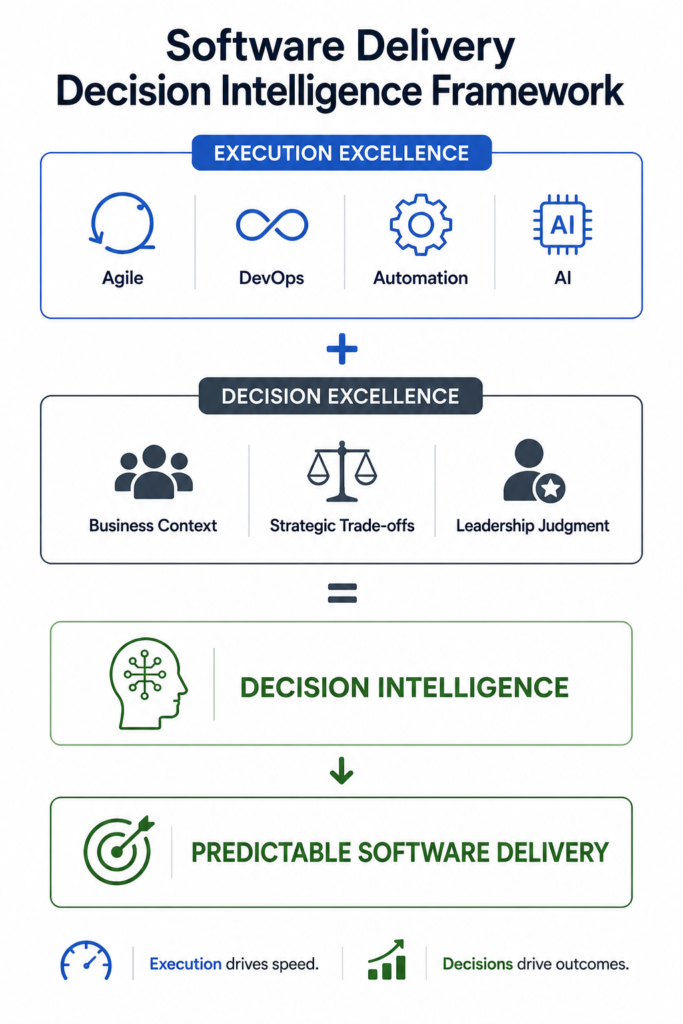
Software Delivery Decision Intelligence Framework showing how Execution Excellence and Decision Excellence combine to create Decision Intelligence, leading to Predictable Software Delivery.

We’ve Optimized Execution. But Not Decision Quality.

What We’ve OptimizedWhat We’ve Often Overlooked
Sprint VelocityDecision Quality
Delivery SpeedBusiness Priorities
AutomationStrategic Trade-offs
ProductivityLeadership Judgment
Agile PracticesOutcome Quality
Delivery MetricsDecision Effectiveness

Every successful software initiative is shaped by a series of decisions long before the first line of code is written. Which customer problem deserves priority? Which features create the greatest business value? Should technical debt be addressed now or deferred? Is a release ready, or should it wait? How should limited resources be allocated when priorities change?

These aren’t engineering decisions.

They’re leadership decisions.

Yet unlike delivery metrics, the quality of these decisions is rarely measured, consistently evaluated, or intentionally improved.

This creates an uncomfortable reality.

Two organizations can adopt the same Agile framework, use the same cloud platform, invest in the same AI tools, and employ equally talented engineers. One consistently delivers products that create measurable business value, while the other struggles with missed expectations, delayed outcomes, and recurring executive escalations.

The difference is rarely execution.

More often, it’s the quality of the decisions made throughout the delivery lifecycle.

Execution builds software. Decisions build outcomes.

For years, we’ve treated software delivery as an execution challenge. If you’re interested in why accurate planning remains one of the foundations of predictable delivery, read my guide on Software Project Estimation Guide.

We invested in improving processes, accelerating engineering, and increasing productivity. Those investments were necessary, and they continue to create tremendous value.

But execution is no longer the industry’s greatest competitive differentiator.

The organizations that lead the next generation of software delivery will be those that consistently make better decisions under uncertainty. They will know how to balance business priorities with technical realities, evaluate trade-offs with confidence, and respond to change without losing strategic direction.

The future of software delivery won’t be defined by faster execution alone.

It will be defined by better decisions.

That raises an important question.

If better execution is no longer enough, what capability enables leaders to consistently make better delivery decisions? This is where Decision Intelligence in Software Delivery begins to matter, because predictable delivery depends as much on leadership judgment as execution discipline.

We’ll answer that in the next section.

Agile Improves Execution. AI Improves Productivity. Decision Intelligence Improves Leadership Decisions.

One assumption has quietly shaped software delivery for years.

If we improve execution, delivery outcomes will naturally improve.

It’s an understandable assumption. Every major evolution in our industry has focused on helping teams execute better. Agile made software delivery more adaptive. DevOps accelerated the flow from development to production. Today, AI is helping engineering teams work faster than ever before. Decision Intelligence in Software Delivery doesn’t replace Agile or AI. It strengthens both by improving the quality of leadership decisions that shape planning, prioritization, execution, and business outcomes.

Each of these advancements has created enormous value.

But after leading software delivery initiatives across different industries, teams, and business environments, I’ve observed something that isn’t discussed often enough.

In my experience, organizations rarely fail because they lack execution capability. More often, they struggle because critical delivery decisions are made without enough business context, delivery insight, or strategic alignment.

I’ve worked with highly capable Agile teams that delivered every sprint as planned, yet the product failed to achieve its business objectives. I’ve also seen technically strong teams spend months building features that customers never used, while more critical business priorities waited for attention.

The execution was excellent.

The decisions were not.

Agile improves execution.

AI improves productivity.

Neither replaces executive judgment.

Every day, delivery leaders make decisions that shape the success or failure of an initiative. Should a release be delayed to address technical debt, or should the organization meet a contractual commitment and accept higher operational risk? Decisions like these rarely have perfect answers. They require business context, delivery insight, experience, and the confidence to balance competing priorities under uncertainty.

That is why two organizations with similar engineering talent, comparable Agile maturity, and access to the same AI capabilities can produce completely different business outcomes. Their engineering capabilities may be nearly identical, but their decision-making capabilities are not. One organization identifies risks early, aligns delivery with business priorities, and adapts confidently as conditions change. Another reacts too late, struggles with conflicting priorities, and mistakes efficient execution for successful delivery.

The difference is rarely execution.

More often, it is the quality of leadership decisions.

This is where I believe software delivery is entering its next stage of evolution.

For years, we’ve invested in improving how software is built. The next competitive advantage will come from improving how software delivery decisions are made. Organizations that strengthen this capability won’t replace Agile or AI. They’ll amplify the value of both by ensuring faster execution and higher productivity are consistently directed toward the right business outcomes.

That naturally raises the next question.

What does better decision-making actually look like in modern software delivery?

Before we answer that, we first need to define the capability that combines business context, delivery insight, human judgment, and intelligent technology to support better leadership decisions.

Executive Comparison

CapabilityPrimary ContributionLeadership Responsibility
AgileBetter executionAlign delivery with business priorities
AIGreater productivityEvaluate strategic trade-offs
Decision IntelligenceBetter leadership decisionsDeliver predictable business outcomes

Decision Intelligence Starts Where Frameworks End

Early in my career, I believed successful software delivery was primarily the result of disciplined execution. If a project was well planned, the team was capable, risks were actively managed, and delivery stayed on schedule, success seemed almost inevitable. For a time, that belief held true because the projects I managed were relatively predictable and the variables were easier to control.

As my responsibilities expanded, so did the complexity of the delivery environment. Leading larger programs meant balancing competing business priorities, managing executive stakeholders, responding to changing customer expectations, and making decisions with incomplete information. It was during this period that I began to notice a recurring pattern. Projects rarely became unpredictable because teams failed to execute. More often, they became unpredictable because the decisions guiding execution gradually drifted away from the business objective.

The signs were rarely dramatic. A strategic priority changed but the delivery plan remained the same. A customer commitment was made before engineering had fully assessed the impact. An architectural compromise that seemed acceptable in one sprint became a significant constraint several months later. Individually, these decisions appeared reasonable. Collectively, they shaped whether the project delivered meaningful business value or simply delivered software on time.

That realization fundamentally changed the way I think about software delivery. Agile remains one of the most important advances in modern software development, and I believe AI will continue transforming the way software is designed, built, and delivered. Yet neither has altered what I now consider the primary responsibility of a delivery leader: making consistently better decisions in environments where certainty is limited and trade-offs are unavoidable.

Over time, I stopped looking for perfect answers and started asking better questions. Whenever I face an important delivery decision, whether it involves approving a release, responding to changing business priorities, investing in technical debt, or reallocating delivery capacity, I deliberately pause before discussing timelines or solutions. Experience has taught me that the quality of the questions asked at the beginning of a discussion often determines the quality of the decision reached at the end.

Those questions have gradually become the thinking model I rely on before making commitments that can influence months of delivery effort. I refer to it as The Delivery Decision Compass because its purpose is not to prescribe a process, but to help leaders navigate uncertainty with greater clarity and confidence. 
For me, Decision Intelligence in Software Delivery isn’t another framework to implement. It is a leadership capability that helps organizations make consistently better delivery decisions in complex and uncertain environments. The Delivery Decision Compass is simply the practical thinking model I use to apply that capability.

The Delivery Decision Compass

Before making a significant software delivery decision, I return to five questions that have consistently helped me balance business priorities, delivery realities, and long-term outcomes.
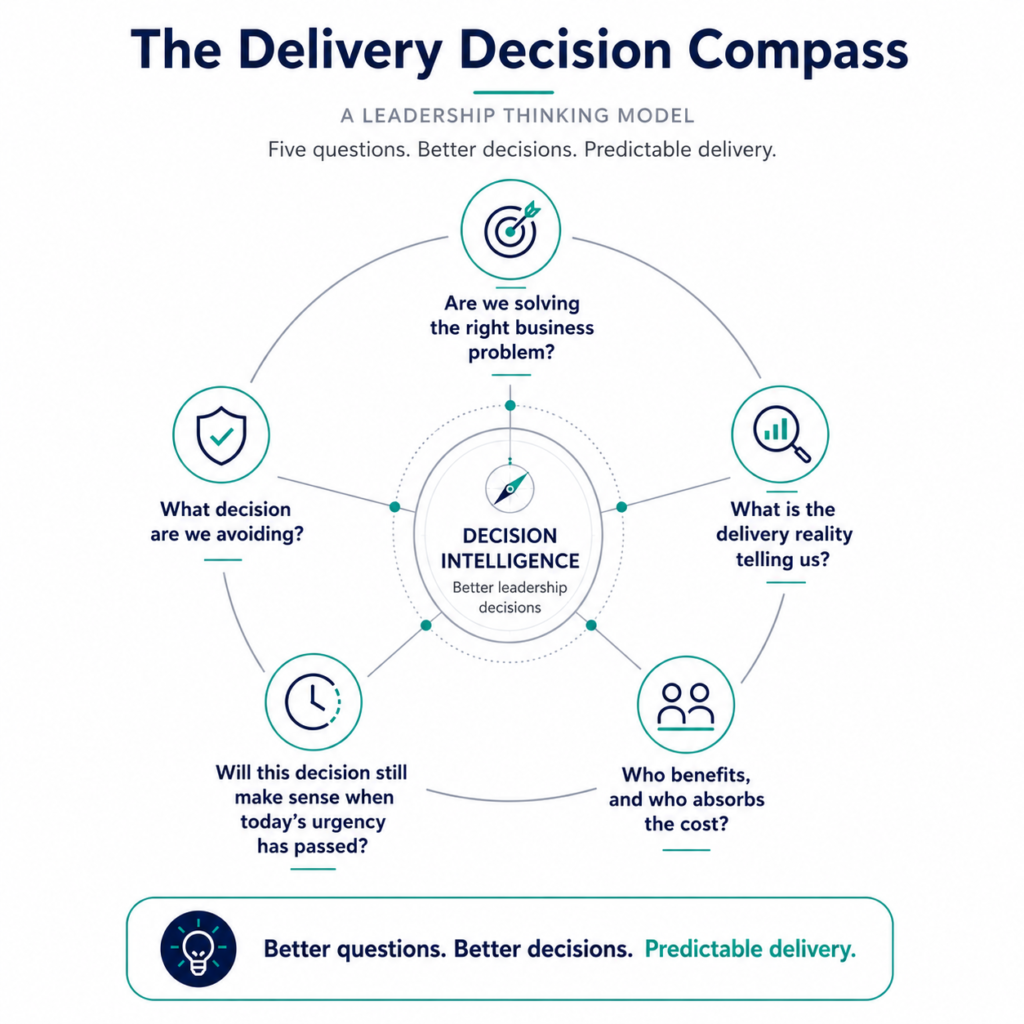
The Delivery Decision Compass showing five leadership questions that help software delivery leaders make better decisions and improve predictable delivery outcomes.

Are we solving the right business problem?

An elegant technical solution has little value if it addresses the wrong business need. Before discussing implementation, I want to be confident that the decision supports the strategic outcome the organization is trying to achieve rather than simply responding to the latest request.

What is the delivery reality telling us?

Delivery dashboards provide valuable information, but they only tell part of the story. Metrics report what has happened. Leadership requires interpreting what those signals mean, identifying emerging risks, understanding hidden dependencies, and recognising changes that have not yet appeared in formal reporting.

Who benefits, and who absorbs the cost?

Every delivery decision creates trade-offs. Accelerating one initiative often delays another. Reducing technical debt may postpone a customer commitment. Accepting additional scope may increase operational complexity. Understanding who gains and who carries the consequences helps create decisions that remain balanced over time.

Will this decision still make sense when today’s urgency has passed?

Many delivery decisions are made under intense pressure. The immediate deadline often dominates the conversation, yet the consequences extend well beyond the current sprint or release. I have found that stepping back to consider the longer-term impact leads to decisions that remain defensible long after the immediate pressure has disappeared.

What decision are we avoiding?

This has become one of the most revealing questions I ask. Projects rarely fail because of a single poor decision. More often, they struggle because leaders postpone difficult conversations, delay uncomfortable trade-offs, or wait for certainty that never arrives. Identifying the decision that everyone recognises but nobody wants to make often changes the direction of the entire discussion.

I don’t view these questions as a checklist or another delivery framework. They are a way of improving the quality of leadership judgment. They encourage more thoughtful conversations, challenge assumptions before commitments are made, and help expose risks while there is still time to respond.

This, in my view, is where Decision Intelligence begins.

Decision Intelligence is not another Agile methodology, governance process, or AI capability. It is the leadership discipline of combining business context, delivery insight, technical understanding, human judgment, and intelligent technology to make consistently better software delivery decisions.

The more I reflect on successful delivery organizations, the more convinced I become that their advantage rarely comes from having better tools or faster engineering teams. Many organizations have access to the same technologies, delivery frameworks, and AI capabilities. What consistently differentiates the strongest leaders is the quality of the decisions they make when the path forward is uncertain.

Execution builds software. Decisions build outcomes.

Agile strengthens execution. AI accelerates productivity. Decision Intelligence ensures both remain aligned with the decisions that ultimately determine whether software delivers lasting business value.

This naturally leads to the next question.

What happens when leaders consistently apply this way of thinking to real software delivery challenges?

Decision Intelligence Starts With Better Questions

There was a time when I believed successful software delivery was primarily about disciplined execution.

If the project was well planned, the team was capable, risks were actively managed, and delivery stayed on schedule, success would naturally follow.

For a while, that belief proved true.

Then my responsibilities changed.

I began leading larger programs, working with executive stakeholders, balancing competing business priorities, and delivering products across different industries. As delivery became more complex, I noticed something that every experienced technology leader eventually encounters.

Projects rarely became unpredictable because teams lost control of execution.

They became unpredictable because the decisions guiding execution kept changing.

A business priority shifted.

A release date changed.

An architectural compromise was accepted.

A customer commitment was made before delivery teams were consulted.

Individually, none of these decisions appeared significant.

Collectively, they determined whether a project delivered business value or simply delivered software.

That realization fundamentally changed how I think about software delivery.

Today, I still believe Agile is one of the most important advances in modern software development. I also believe AI will continue transforming the way software is designed, built, and delivered.

But neither has changed what I consider to be the most important responsibility of a delivery leader.

Making better decisions.

Consistently.

Over the years, I’ve stopped looking for perfect answers.

Instead, I’ve learned to ask better questions.

Whenever I’m making an important delivery decision, whether it’s approving a release, changing priorities, investing in technical debt, responding to customer demands, or reallocating delivery capacity, I pause before discussing timelines or solutions.

I ask myself the same five questions.

Over time, they have become the Delivery Decision Compass I rely on before making commitments that can influence months of delivery effort.

The Delivery Decision Compass

The Delivery Decision Compass showing five leadership questions that help software delivery leaders make better decisions and improve predictable delivery outcomes.

1. Are we solving the right business problem?

The best technical solution has little value if it addresses the wrong business need. Every significant decision should strengthen the business objective, not simply satisfy the latest request.

2. What is the delivery reality telling us?

Dashboards report progress.

Leaders interpret signals.

Delivery data should reveal emerging risks, dependencies, changing trends, and execution patterns before they become delivery problems.

3. Who benefits, and who absorbs the cost?

Every decision creates trade-offs. Accelerating one priority often delays another. Strong delivery leaders make those trade-offs visible before making commitments.

4. Will this decision still make sense when today’s urgency has passed?

The pressure to deliver is immediate.

The consequences of today’s decisions often last much longer.

The best leaders balance short-term delivery commitments with long-term business success.

5. What decision are we avoiding?

In my experience, projects rarely fail because of one bad decision.

More often, they fail because difficult decisions are postponed until they become unavoidable.

Delaying a priority change.

Ignoring technical debt.

Avoiding difficult stakeholder conversations.

Waiting for perfect information.

Leadership isn’t about avoiding difficult decisions.

It’s about making them at the right time.

I don’t treat these questions as a checklist.

I use them to improve the quality of my thinking.

They help me challenge assumptions before making commitments, expose risks while there is still time to respond, and encourage conversations that balance business priorities with delivery realities.

To me, this is where Decision Intelligence begins.

It isn’t another Agile framework.

It isn’t another governance process.

It isn’t another AI capability.

It’s the leadership discipline of combining business context, delivery insight, technical understanding, human judgment, and intelligent technology to consistently make better software delivery decisions.

Execution builds software. Decisions build outcomes.

Agile strengthens execution.

AI accelerates productivity.

Decision Intelligence ensures both remain aligned with the decisions that create meaningful business value.

I believe the future of software delivery won’t belong to the organizations that simply execute faster.

It will belong to the organizations whose leaders consistently make better decisions.

That naturally raises the next question.

How does Decision Intelligence change the way software delivery leaders manage projects, programs, and portfolios every day?

Where Decision Intelligence Changes Everything

Frameworks are valuable because they provide structure. Processes create consistency. Metrics improve visibility. AI increases productivity. Yet none of these capabilities makes the difficult decisions that ultimately determine whether a software initiative succeeds or fails. Those decisions still belong to leaders. Looking back over more than two decades in software delivery, I’ve come to believe that the difference between predictable and unpredictable delivery rarely lies in the quality of execution alone. More often, it lies in the quality of leadership judgment when circumstances become uncertain and the obvious path forward disappears.

The Delivery Decision Compass has become valuable to me because it changes the way I approach those moments. It doesn’t provide ready-made answers, nor does it eliminate difficult trade-offs. Instead, it encourages a different conversation by replacing assumptions with questions, slowing down reactive thinking, and creating space for better decisions. I’ve seen that shift repeatedly in situations that initially appeared to be delivery problems but ultimately proved to be leadership decisions.

When Delivery Dates Become the Wrong Conversation

One situation has repeated itself throughout my career. A strategic customer requests a capability that could strengthen an important commercial relationship. Sales wants to respond quickly because the opportunity is significant, while Engineering provides an estimate based on the effort required to deliver the work responsibly. The discussion quickly becomes focused on delivery dates, with every participant trying to answer the same question: can we commit sooner?

Experience has taught me that this is rarely the right question. Before discussing timelines, I want to understand whether the requested feature is actually the best solution to the customer’s business problem. In many cases, it isn’t. Customers often describe the solution they believe they need rather than the outcome they are trying to achieve. Once that distinction becomes clear, the conversation changes completely. Instead of negotiating dates, the team begins exploring alternative ways to deliver value. A phased release, a reduced scope, or a different implementation approach often satisfies the business objective without introducing unnecessary delivery risk or disrupting commitments already made elsewhere.

What initially appeared to be a scheduling discussion becomes a business discussion. The outcome is usually a decision that creates greater value for the customer while preserving the integrity of the delivery plan. I’ve learned that the fastest commitment is not always the best commitment. More often, the best decision begins with understanding the problem before attempting to optimise the solution. Leaders interested in strengthening this capability can explore my Software Project Estimation Guide for practical estimation techniques. More often, the best decision begins with understanding the problem before attempting to optimise the solution.

When Delivery Metrics Tell Only Part of the Story

Some of the highest-risk programmes I’ve worked on appeared remarkably healthy when viewed through traditional delivery reporting. Sprint commitments were consistently achieved, velocity remained stable, milestone reporting stayed green, and governance reviews reflected positive progress. Anyone looking only at the dashboard would reasonably conclude that the programme was performing well.

The conversations outside the dashboard told a different story. Business stakeholders were gradually losing confidence because market priorities had changed. Technical teams were accepting architectural compromises simply to protect short-term commitments. Small delivery risks that seemed manageable in isolation were quietly accumulating into a level of complexity that threatened future releases. None of these concerns appeared in the reporting, yet they represented the greatest risks facing the programme.

Those experiences changed the way I interpret delivery data. I no longer ask whether a dashboard is green. Instead, I ask what reality exists beyond the metrics. Delivery reports provide valuable evidence, but they cannot replace leadership judgment. Metrics explain what has already happened. Leaders must determine what today’s information means for tomorrow’s decisions. In my experience, organisations become more predictable when leaders learn to interpret delivery signals rather than simply monitor delivery metrics.

The Decisions That Leaders Delay

The most difficult decisions in software delivery are rarely hidden. In fact, leadership teams usually recognise them long before they are discussed openly. A release should probably be delayed because the risk profile has changed. Technical debt has reached a point where it threatens future delivery. A strategic initiative no longer reflects the organisation’s priorities. Stakeholder expectations have become unrealistic, yet nobody wants to be the first person to challenge them.

One question has consistently helped me navigate these situations.

What decision are we avoiding?

I’ve found that this question changes the discussion because it shifts attention away from symptoms and toward underlying causes. Instead of debating schedules or status reports, leaders begin examining assumptions, confronting uncomfortable trade-offs, and acknowledging risks that have quietly become accepted as normal. Those conversations are rarely easy, but they almost always happen early enough to influence the outcome rather than simply explain it afterwards.

In my experience, organisations rarely struggle because leaders make one catastrophic decision. More often, they struggle because necessary decisions are postponed until the available options become increasingly limited and significantly more expensive. Leadership is not demonstrated by avoiding difficult conversations. It is demonstrated by having those conversations while meaningful choices still exist.

Better Questions Lead to Better Decisions

Reflecting on these experiences, I’ve become convinced that successful software delivery depends on more than capable engineering teams, mature Agile practices, or increasingly sophisticated AI capabilities. Those investments improve execution, and they unquestionably matter. However, organisations with similar delivery maturity often produce dramatically different business outcomes because their leaders approach critical decisions differently.

The strongest delivery organisations I’ve encountered are not distinguished by having perfect information or flawless execution. They are distinguished by leaders who consistently ask better questions before making important commitments. Those questions expose assumptions, clarify business priorities, reveal hidden risks, and encourage balanced discussions before decisions become difficult to reverse. Over time, that way of thinking creates an organisation that is not only more disciplined in execution but also more resilient when conditions inevitably change.

That is why I believe Decision Intelligence is not another methodology to implement alongside Agile or AI. It is a leadership capability that improves the quality of every decision made within those frameworks. Agile strengthens execution. AI accelerates productivity. Decision Intelligence ensures both remain aligned with the business outcomes they are ultimately intended to achieve.

Execution builds software. Decisions build outcomes.

The question, then, is no longer whether Decision Intelligence matters.

The more important question is how organisations can develop it consistently, so that better decision-making becomes an organisational capability rather than depending on the experience of individual leaders.

From Individual Judgment to Organizational Capability

One of the biggest shifts in my own leadership didn’t come from learning another delivery framework or adopting a new technology. It came when I stopped measuring success by the quality of the decisions I personally made and started measuring it by the quality of the decisions the organization could make without me.

That change took time.

Early in my career, I believed strong delivery leaders solved difficult problems themselves. Experience gradually taught me something different. As delivery organizations grow, complexity increases far beyond the capacity of any individual leader. Sustainable success depends on creating an environment where good decisions are made consistently across delivery managers, product leaders, architects, engineering teams, and business stakeholders. The goal is no longer to become the smartest decision-maker in the room. The goal is to build an organization where better decision-making becomes part of the culture.

When I reflect on the organizations that consistently delivered predictable outcomes, I see three characteristics that consistently set them apart.

Organizations that invest in Decision Intelligence in Software Delivery are not simply improving project execution. They are building a long-term capability for making better business and delivery decisions at every level of the organization. Over time, that capability becomes a competitive advantage because better decisions are no longer dependent on individual experience—they become part of how the organization operates.

Great Delivery Organizations Start With Business Decisions

One of the clearest differences I’ve observed between high-performing and average delivery organizations is the way important conversations begin. Average organizations often start by discussing delivery schedules, sprint commitments, resource allocation, or release milestones. High-performing organizations begin somewhere else. They first ask whether the work still supports the business objective and whether the original assumptions remain valid.

That difference may appear subtle, but it influences every decision that follows. When business context remains at the centre of delivery discussions, changing priorities become easier to recognise, trade-offs become easier to justify, and teams become more comfortable adapting plans when circumstances evolve. Delivery stops being an exercise in protecting commitments and becomes a discipline focused on protecting business value.

I’ve learned that the strongest delivery leaders deliberately bring business context back into every significant conversation. They understand that priorities evolve continuously, and decisions that were correct three months ago may no longer be the right decisions today. Organizations become more predictable when business decisions consistently guide delivery decisions rather than the other way around.

Great Organizations Develop Better Decision Makers

Many organizations invest heavily in improving delivery performance. They refine Agile practices, monitor delivery metrics, introduce new governance processes, and increasingly adopt AI-powered tools to improve productivity. These investments strengthen execution, but execution alone does not determine delivery success.

The organizations that consistently outperform others invest just as deliberately in improving leadership judgment. They encourage leaders to challenge assumptions, welcome constructive disagreement, evaluate alternative options, and become comfortable making decisions despite incomplete information. Instead of rewarding certainty, they reward thoughtful reasoning and responsible decision-making.

This is also where I believe AI will make its greatest long-term contribution. AI can analyse vast amounts of information, identify patterns, and surface insights that would otherwise remain hidden. Those capabilities will continue to improve software delivery. However, deciding which trade-offs are acceptable, balancing customer expectations against technical realities, and accepting accountability for difficult choices will remain fundamentally human responsibilities.

Technology can strengthen judgment.

It cannot replace it.

Organizations that understand this distinction will use AI not to automate leadership, but to make leadership more informed.

Great Organizations Make Better Decisions by Design

The most resilient delivery organizations I’ve worked with share one characteristic above all others. Better decisions are not dependent on one experienced programme manager, one exceptional architect, or one influential executive. They are the natural result of an environment designed to support thoughtful decision-making.

That environment is built gradually. Leaders encourage difficult conversations instead of avoiding them. Transparency is valued more than artificial optimism. Important decisions are reviewed with the same discipline applied to delivery performance, not to assign blame but to improve future judgment. Emerging leaders are coached to think critically, challenge assumptions respectfully, and understand the business consequences of technical decisions.

Over time, those behaviours become habits.

Those habits shape culture.

That culture influences every important decision the organization makes.

This is where I believe Decision Intelligence reaches its full potential. It is no longer the capability of a few experienced leaders. It becomes part of the organization’s operating model, influencing decisions at every level of software delivery.

Organizations that achieve this don’t simply execute software delivery more efficiently.

They make better decisions more consistently.

And over time, that becomes one of the most sustainable competitive advantages any technology organization can build.

The Organizations That Win Won't Build Faster. They'll Decide Better.

For most of the history of software development, competitive advantage came from execution. Organizations that planned better, delivered faster, and executed more consistently outperformed those that didn’t. Every major shift in our industry, from Agile and DevOps to cloud computing and AI-assisted development, has steadily improved the way software is built.

What is changing now isn’t simply the pace of software delivery. It’s the location of competitive advantage.

Capabilities that once differentiated organizations are becoming widely accessible. AI can help almost every development team write code faster. Cloud platforms have made world-class infrastructure available to organizations of every size. Modern engineering practices are no longer reserved for technology leaders; they have become the expected standard for successful software delivery.

As these capabilities become increasingly common, they become less effective as differentiators.

That doesn’t make them less important.

It makes them less unique.

The next competitive advantage will not come from access to better tools. It will come from making better decisions about how those tools are applied. Two organizations may use the same AI platforms, follow similar engineering practices, and employ equally talented people, yet achieve dramatically different business outcomes because their leaders make different decisions about priorities, investment, architecture, customer value, and acceptable risk.

In other words, software development is gradually becoming democratized.

Decision quality is not.

That distinction, I believe, will define the next decade of software delivery.

Organizations will continue investing in AI because they should. They will continue modernizing engineering practices because they must. But the organizations that consistently outperform their competitors won’t do so because they adopted technology first. They will outperform because they built leadership teams capable of making better decisions when the right path was uncertain, the available information was incomplete, and every option involved meaningful trade-offs.

Looking back, this has always been true.

The difference is that technology is making the gap far more visible.

As execution becomes easier, judgment becomes more valuable.

As AI becomes more capable, leadership decisions become more consequential.

As software development becomes increasingly standardized, decision quality becomes increasingly difficult to replicate. The organizations that lead the next generation of software delivery will not necessarily be those that build software faster. They’ll be the ones that consistently decide better.

That is why I believe Decision Intelligence in Software Delivery is not another delivery trend. It is becoming a strategic capability for organizations that want to compete through better leadership decisions.

It is a leadership capability for an industry where execution is steadily becoming commoditized.

The organizations that lead the next generation of software delivery will not necessarily be those that build software faster.

They will be the ones that consistently decide better.

Because execution builds software.

Decision quality builds enduring competitive advantage.

If you’re exploring ways to improve software delivery decision-making in your organization, let’s connect on LinkedIn and continue the conversation.

technical-project-management-services

Jawed Shamshedi is a Senior Technical Project Manager and Software Delivery Leader with 20+ years of experience in IT and 10+ years in technical project management. He holds PMP®, SAFe® 6 RTE, PRINCE2, and MCP certifications and has led software delivery across e-commerce, finance, healthcare, and SaaS domains. Based in New Delhi, working with clients worldwide.

Scroll to Top