

Software Project Estimation Guide: Methods, Cost, Agile, Metrics & Real Examples (2026)
Software project estimation is where most delivery issues start.
Missed deadlines, budget overruns, and constant rework are rarely caused by poor development. In most cases, they originate from assumptions made early, before the full complexity of the project is understood.
Strong estimation is not about predicting exact timelines. It is about making informed decisions, managing uncertainty, and setting realistic expectations before execution begins.
In my experience, estimation failures are rarely due to effort miscalculation. They are more often driven by hidden dependencies, integration complexity, and evolving requirements.
This guide is designed for project managers, solution architects, founders, and product owners who want to build practical and reliable estimation approaches.
With the rise of AI and evolving delivery models, estimation is becoming even more critical in modern software projects.
By the end of this guide, you’ll be able to structure estimates more effectively, improve predictability, and make better delivery decisions using proven techniques, industry models, and real-world insights.
Table of Contents
- Why Software Project Estimation is Important
- Step-by-Step Software Project Estimation Process
- Step 1: Understand Requirements in Detail
- Step 2: Define Scope Clearly
- Step 3: Choose the Right Estimation Technique
- Step 4: Create a Work Breakdown Structure (WBS)
- Step 5: Identify Risks and Dependencies
- Step 6: Choose Estimation Technique
- Step 7: Estimate Effort (Not Just Time)
- Step 8: Estimate Non-Functional and Hidden Effort
- Step 9: Add Risk-Based Buffer
- Step 10: Consider Team Capacity and Validate with Team
- Step 11: Convert Effort into Timeline and Cost
- Step 12: Communicate Estimates to Stakeholders
- Step 13: Continuously Refine Estimates
- How Architecture Impacts Estimation
- Effort vs Duration
- Software Development Cost Estimation
- Agile Estimation Explained
- Estimation Models Used in Industry
- Estimation Metrics Every Project Manager Should Track
- How to Use These Metrics in Real Projects
- Action Thresholds for Decision Making
- Estimation Governance and Control
- Estimation Trade-offs
- Red Flags in Software Estimation
- Common Challenges in Software Estimation
- Quick Estimation Decision Framework
- What Experienced Project Managers Do Differently
- Pro Tips for Better Estimation
- FAQs on Software Project Estimation
- Final Thoughts
- Need Help with Software Project Estimation
Why Software Project Estimation is Important
Accurate estimation helps you:
- define realistic timelines
- allocate resources effectively
- forecast budgets
- manage stakeholder expectations
- identify risks early
Without proper estimation, even well-planned projects struggle during execution.
In my experience, most estimation issues don’t come from development effort but from dependencies and integration gaps.
In one of my projects, we underestimated the effort required for third-party integration. The initial estimate looked reasonable based on available documentation, but real challenges emerged during implementation. What was planned as a 2-week effort extended to nearly 6 weeks, impacting dependent modules and delaying overall delivery.
The issue wasn’t technical capability. It was the assumption that integration complexity would be straightforward. This is a common pattern I’ve seen across projects, where hidden dependencies and external factors significantly impact estimation accuracy.
These challenges are becoming more complex as software development evolves with new technologies and delivery models, as discussed in my article on software development trends for 2025.
Step-by-Step Software Project Estimation Process
Step 1: Understand Requirements in Detail
Start with a clear and structured understanding of:
- functional requirements (features, workflows)
- non-functional requirements (performance, security, scalability)
- user journeys and use cases
- external integrations (APIs, payment gateways, CRM systems)
In most projects, early requirements are incomplete or evolving. Initial estimates based on partial information are often inaccurate and require refinement.
Without structured estimation, even well-designed solutions can fail to meet timelines and delivery expectations.
Step 2: Define Scope Clearly
Define the boundaries of the project:
- in-scope vs out-of-scope items
- assumptions and constraints
- dependencies
A well-defined scope becomes the baseline for estimation and helps prevent scope creep during execution.
Step 3: Choose the Right Estimation Technique
Before breaking down the work, decide how detailed and conservative your estimation approach should be.
Estimation Strategy Based on Project Type
MVP / Startup Product
- high uncertainty
- rough estimation
- focus on speed over precision
Enterprise Systems
- detailed WBS
- include integrations, compliance, security
- bottom-up estimation
Fixed Cost Projects
- conservative estimation
- higher buffer
- risk-adjusted pricing
Time & Material Projects
- flexible estimation
- continuous refinement
Choosing the right strategy ensures your estimation approach aligns with project goals and constraints.
Step 4: Create a Work Breakdown Structure (WBS)
Break the system into smaller, manageable components:
- UI/UX design
- frontend development
- backend services
- database design
- API integrations
- DevOps and infrastructure
- testing (unit, integration, UAT)
- deployment and release
A granular WBS improves estimation accuracy and helps identify hidden work.
Here’s a complete view of the software estimation process:
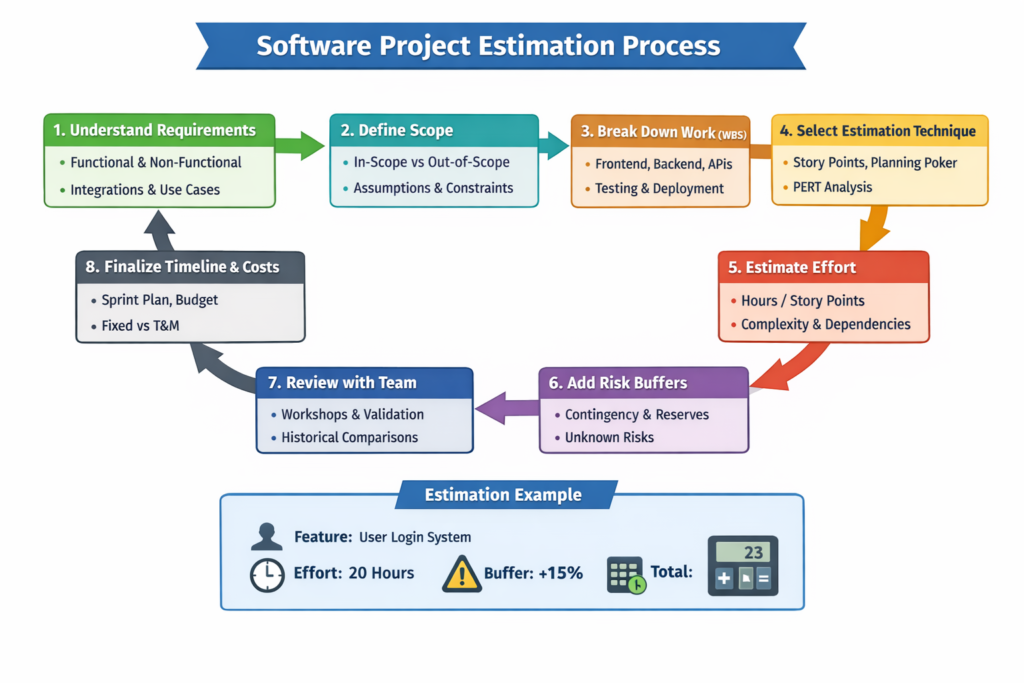
This flow ensures estimation is structured, validated, and continuously refined.
Step 5: Identify Risks and Dependencies
Estimation should always be risk-adjusted.
Identify early:
- third-party integrations
- API readiness
- cross-team dependencies
- technology uncertainties
In real projects, dependencies rarely behave as expected. External APIs, third-party systems, and cross-team coordination often introduce delays that are not visible during initial planning. In practice, integration effort is one of the most underestimated areas in software projects, often leading to cascading delays across dependent modules.
Step 6: Choose Estimation Technique
Select the most suitable estimation method:
- expert judgment
- analogy-based estimation
- bottom-up estimation
- story points (Agile)
- planning poker
- three-point estimation (optimistic, pessimistic, most likely)
For most real-world projects, bottom-up estimation provides the most reliable results but it is often skipped due to time pressure and unrealistic expectations. In practice, relying only on high-level estimation without detailed breakdown is one of the most common reasons projects get misaligned early.
Along with traditional estimation techniques, AI is also influencing how teams analyze data and improve planning decisions, as explained in my article on GPT-5.
Step 7: Estimate Effort (Not Just Time)
Estimate effort in hours or story points.
Consider:
- complexity
- dependencies
- team experience
- reusability
Best practices:
- use ranges (e.g., 40–60 hours)
- assign confidence levels (50%, 80%, 90%)
Initial estimates are often optimistic, particularly in the early stages when requirements and dependencies are not fully understood. Refinement is essential as more information becomes available.
Step 8: Estimate Non-Functional and Hidden Effort
Account for effort beyond core development:
Non-Functional Requirements
- performance optimization
- security implementation
- scalability planning
- logging and monitoring
Hidden Effort Areas
- environment setup (dev, QA, staging)
- CI/CD pipeline setup
- code reviews
- documentation
- stakeholder demos
- production support
These often add 20–30% additional effort if not considered early.
Step 9: Add Risk-Based Buffer
Instead of using a flat percentage, apply:
- contingency buffer (known risks)
- management reserve (unknown risks)
Fixed cost projects without adequate buffer often result in delivery pressure and margin loss, especially when scope changes or unforeseen complexities emerge during execution.
Step 10: Consider Team Capacity and Validate with Team
Adjust estimates based on real execution capacity:
- team velocity (Agile teams)
- actual availability (not 100%)
- parallel workstreams
- context switching
Validate estimates with:
- developers
- QA
- architects
Team capacity is rarely linear. Meetings, context switching, and dependencies reduce actual productive time, so validating estimates with the team is essential to avoid unrealistic planning.
Step 11: Convert Effort into Timeline and Cost
Translate effort into:
- project timeline or sprint plan
- resource allocation
- cost estimation
Example:
- 2 developers × $20/hour × 160 hours = $6,400
Ensure alignment with delivery model (fixed cost vs time & material).
Step 12: Communicate Estimates to Stakeholders
Estimation is not complete until it is clearly communicated and agreed upon.
- present ranges, not fixed numbers
- clearly state assumptions
- highlight risks upfront
- align on trade-offs
- avoid overcommitment under pressure
- Stakeholders often push for aggressive timelines. Avoid committing without analysis.
- Estimation discussions often involve negotiation. Protect your assumptions.
Stakeholders often push for aggressive timelines. Without clear communication of assumptions, risks, and constraints, expectations become unrealistic even when estimates are technically sound.
In my experience, overcommitment under pressure is one of the most common reasons estimates fail, even when the technical approach is correct.
Step 13: Continuously Refine Estimates
Estimation is an ongoing process.
- refine during backlog grooming
- adjust after each sprint
- update based on actual velocity
Velocity becomes reliable only after a few sprints. Continuous refinement is essential for accuracy.
How Architecture Impacts Estimation
Architecture decisions directly influence effort and timelines.
Consider:
- monolith vs microservices
- number of services/modules
- third-party integrations
- data migration complexity
- cloud vs on-prem deployment
Architecture complexity can increase effort by 30–50%.
Effort vs Duration
Effort and duration are not the same.
- Effort is the total work required (in hours or story points)
- Duration is the calendar time to complete that work
Example:
- 40 hours of effort
- 1 developer → 5 days
- 2 developers → ~2.5–3 days
Adding more resources does not always reduce duration proportionally due to dependencies, coordination, and communication overhead.
In real projects, duration is driven more by sequencing and dependencies than effort alone.
Software Development Cost Estimation
Software development cost is derived from the total effort required and the cost of resources.
Key factors influencing cost:
- team size and roles (frontend, backend, QA, DevOps)
- hourly or monthly rates
- project duration
- complexity and integrations
Example:
- 2 developers × $20/hour × 160 hours = $6,400
Common pricing models:
- Fixed Cost → suitable for well-defined scope
- Time & Material → flexible, based on actual effort
- Cost per Sprint → used in Agile delivery
In practice, cost estimation should always include buffer for risks and changes. Underestimating cost often leads to delivery pressure and compromises in quality.
Agile Estimation Explained
In Agile:
- work is estimated using story points
- planning poker is used for alignment
- delivery is based on team velocity
Velocity becomes reliable only after a few sprints, once the team stabilizes and dependencies are better understood. Early sprint data is usually inconsistent and should not be used for long-term forecasting.
Estimation Models Used in Industry
For large-scale projects:
- Function Point Analysis
- COCOMO model
- Lines of Code
Estimation Metrics Every Project Manager Should Track
Estimation without measurement is incomplete.
- estimation accuracy
- estimation variance
- velocity
- planned vs actual effort
- schedule variance
- cost variance
- burn rate
- defect leakage
- rework percentage
- scope change rate
These metrics enable continuous improvement.
How to Use These Metrics in Real Projects
Metrics should not be tracked for reporting alone. They must directly influence planning decisions.
Tracking metrics is useful only when they drive decisions.
In real projects, use them like this:
- track estimation accuracy after every sprint
- if variance exceeds 20%, re-estimate the backlog
- use velocity trends to forecast release timelines
- monitor rework percentage to identify requirement gaps
- review planned vs actual effort to improve future estimates
Action Thresholds for Decision Making
Without clear thresholds, metrics become reporting data instead of decision tools.
Metrics become powerful only when they trigger actions.
Use these thresholds as guidelines:
- if estimation accuracy < 80% → revisit estimation approach
- if rework > 15% → improve requirement clarity
- if velocity fluctuates > 20% → stabilize team and reduce disruptions
Estimation Governance and Control
Estimation is a continuous governance process.
Implement:
- estimation baseline approval
- change control
- variance tracking
- sprint-level reviews
Maintain historical estimation data.
Estimation Trade-offs
Every estimate involves trade-offs:
- speed vs accuracy
- cost vs quality
- scope vs timeline
Reducing timeline may require:
- more resources
- reduced scope
- increased cost
Red Flags in Software Estimation
Watch for:
- vague requirements
- aggressive deadlines
- missing dependencies
- lack of stakeholder alignment
Common Challenges in Software Estimation
- unclear requirements
- integration complexity
- ignored NFRs
- unrealistic expectations
- lack of historical data
What Experienced Project Managers Do Differently
- use data instead of assumptions
- estimate using ranges
- validate with teams
- communicate risks early
- continuously refine estimates
Pro Tips for Better Estimation
- break work into smaller units
- involve cross-functional teams
- validate assumptions early
- track estimates vs actuals
FAQs on Software Project Estimation
How accurate should estimates be?
Typically within 10–30%.
What is the best estimation technique?
Bottom-up with Agile methods.
How often should estimates be updated?
After each sprint.
Final Thoughts
Accurate software project estimation is not about getting numbers right the first time.
It’s about making informed decisions, managing uncertainty, and continuously improving based on real delivery experience.
In real projects, estimation is never perfect. But with the right approach, it becomes reliable enough to guide planning, set expectations, and reduce delivery risk.
The difference between successful and failed projects is rarely development capability.
It is the quality of decisions made during estimation.
Need Help with Software Project Estimation?
If your project estimates lack clarity on timelines or budgets, I can help you build a structured estimation approach and improve delivery predictability. Explore my Work With Me page or get in touch to discuss your requirements.